Led by member and IU curator Sherry Rouse, BPC members toured the Wells House in July.
By Ron Johnson
Nearly two dozen BPC members absorbed Indiana University history on a July 26 field trip to the Herman B Wells House.
Wells was IU president from 1937 to 1962, and he continued as chancellor until his death in 2000.
He remains a university icon. The university grew exponentially during Wells’ presidency, and his imprints on the university were numerous and long lasting. He recruited nationally-renowned faculty, supervised planning and construction, developed and preserved green space, and led desegregation on campus.
Starting in 1961, the federal-style house on 10th Street, across from IU’s Wells Library, was his home.
Leading the tour was BPC treasurer Sherry Rouse, the curator of campus art for the IU Office of Risk Management.
The two-bedroom house had been built in 1939 by Lloyd and Lillian (Riley) Setser. Lloyd was IU’s first full-time real-estate manager, and Lillian was an antique dealer and former schoolteacher.
The scalloped wood trim, French doors and secluded back yard reflected Wells, Rouse said. So did the art and antique furniture and glassware he acquired from near and far, not just for his house, but for other campus buildings.
After Wells’ death, furnishings were eventually dispersed and/or sold. Among Rouse’s duties, she said, was the long-term challenge to refurbish the house with period pieces, including some of Wells’ own furniture, art and glassware.
BPC members ate lunch above what was once Wells’ swimming pool, now a small banquet room at the rear of the house. Rouse then led members through the first-floor breakfast room, dining room, living room and study, before moving to the second-floor master bedroom, guest room and study.
Bloomington Press Club takes a field trip for its meeting at noon July 26 to tour the Wells House, home of the late IU chancellor and president Herman B Wells.
Treasurer Sherry Rouse will lead us on a tour to see the artifacts from the life and times of one of IU’s legends.Wells purchased the house at 10th and Jordan when he retired as president (but as everyone knows, he did not retire from his career as IU’s biggest fan, appearing at functions around campus with regularity). He bequeathed the house to IU upon his death, and now it is used for special events and functions.
The scoop:
Lunch will be catered by Affairs of the Sun and will cost $10 for a boxed lunch with turkey, ham or veggie sandwich, pasta salad, fruit and cookie, and drink.
Parking is near the house, but in limited supply. Consider carpooling if possible.
The food is ordered in advance, so no RSVP, no food! Be sure to e-mail Sherry at srouse@indiana.edu by July 20 to make sure you get your grub.
Sheriff Jim Kennedy talked about the challenges he's faced as a law enforcement leader. (Photo by Jack Dvorak)
By Jack Dvorak
A good investigative reporter is one of the biggest assets law enforcement agencies can have, Monroe County Sheriff Jim Kennedy told 37 Bloomington Press Club members and guests at the June 28 meeting.
Kennedy said when the media and law enforcement agencies work together, many good things can happen. But he also noted that people in these agencies need to know when the press is a friend and when it could be an enemy.
In his 40 years with various federal, state and local law enforcement entities, Kennedy said he and many others in the business have been to schools and special training sessions to learn how to deal properly with the media, and sometimes the instruction incorrectly labeled the media as an enemy.
“I have friends in the news media and have been blessed by that, and I have some reporters I don’t divulge everything to. The relationship must be based on trust,” Kennedy said.
He mentioned that not following federal and state open records laws on the part of some law enforcement agencies is “reprehensible and illegal” and as a result the relationships among media and the agencies are tenuous.
However, he said, “I’ve never had any real troubles with the media.”
Kennedy said that a large part of his job does not involve law enforcement as such but involves budgetary and personnel matters with county government.
For example, he oversees an annual budget of around $7 million, the largest share of which involves keeping the jail operating with its 60 full-time staff members. The correctional center serves about 850 meals a day to the approximately 250 inmates and staff members who work there, and this must be done within an allowance of $1.19 per meal.
Other departments that Kennedy supervises include the sheriff’s office itself with 32 deputies covering the 130,000 population of Monroe County; the Animal Control operation with its budget of more than $300,000; and the Central Emergency Dispatch Center, shared with the Bloomington Police Department and which is staffed by 10 full-time and one part-time dispatcher provided by the Sheriff’s Department with the remaining 13 employees being paid from city and other budgets.
Kennedy said he would like a larger staff of deputies, as at times only three are on duty in any one shift to serve the 394 square miles of the county. While Bloomington police might answer a call within three minutes for those in the city limits, sometimes it might take a sheriff’s deputy an hour to get to a distant place in the county, especially if the officers are attending to another call.
Also with regard to a tight budget, he said he regrets that his highest paid deputy makes less than the lowest paid IU police officer.
In order to stay within budgets, Kennedy said that while the Correctional Center is very clean, he has had to take some added belt-tightening measures to ensure inmate health and well-being. For example, he did away with a basketball hoop and a volleyball net in the courtyard because medical bills on a blown-out knee would cost the county $10,000.
Inmates are no longer involved in a work-release program, either, because many of them on such programs in the past would be responsible for bringing back to the jail contraband materials such as illegal drugs.
Kennedy said the county spends more than $500,000 in its latest budget for psychological help for prisoners, many of whom do not consider consequences of their behavior before committing crimes, the most common of which is theft. He said the recidivism rate for the inmates is about 67 percent.
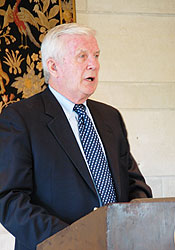
Kennedy said the relationship between law enforcement and the media must be based on trust. (Photo by Jack Dvorak)
He said he would like to see more emphasis on crime prevention to occur when people are much younger, even for elementary school-aged children rather than having to spend so many resources after people have become young adults.
Kennedy was introduced by Press Club President Del Brinkman as “perhaps the most qualified sheriff in the country” because he earned a bachelor’s in business from IU, a law degree from the IU School of Law, and is also a graduate of the FBI’s National Academy. He is a retired colonel in the U.S. Army and has earned a diploma from the U.S. Army Command and General Staff College.
In addition to his holding the office of sheriff for the past three and a half years, Kennedy has also been a U.S. marshal, chief of the IU Police Department and chief of the Bloomington Police Department.
The next scheduled Press Club meeting is July 26 at the recently renovated Wells House across from IU’s Herman B Wells Library.
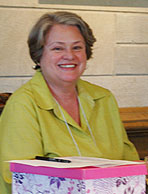
Treasurer Sherry Rouse is ready to take your lunch reservation for the next meeting. (Photo by Jack Dvorak)
Bloomington Press Club meets at noon June 28 in the Coronation Room of the Indiana Memorial Union. Our speaker this month is Monroe County Sheriff Jim Kennedy, who is running for re-election and whose resume includes experience as a U.S. Marshal, chief of police for both the City of Bloomington and IU, deputy prosecutor, deputy coroner and colonel in the U.S. Army.
The meeting begins with lunch at noon, followed by Kennedy’s talk and Q&A. Cost is $14 for the full buffet, $12 for salad and dessert bars. RSVP to Sherry Rouse, srouse@indiana.edu, by June 23 if you plan to attend.
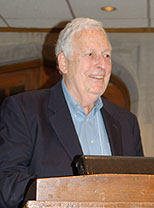
Music reviewer and IU professor emeritus Peter Jacobi talked about how he evaluates a performance. (Photo by Jack Dvorak)
Music and arts columnist Peter Jacobi made sure the 35 Bloomington Press Club members at the May 24 luncheon meeting paid attention to his remarks by playing Joseph Haydn’s “Great Surprise” symphony just after he was introduced.
For Jacobi, surprise is one of 13 “wants” he lists as essentials in experiencing music and other artistic endeavors. And while it’s not possible usually to have all 13 wants fulfilled in a concert or performance, the more the better, Jacobi said.
Jacobi is a professor emeritus in IU’s School of Journalism, where he continues to teach one course each semester: magazine reporting in the fall and arts reporting in the spring. He attends hundreds of local performances each year while reviewing for the Herald-Times. He also writes columns for Editors Only magazine and others, and he is a writing and speaking consultant for various professional organizations. Before coming to IU in 1985, he was on the faculty of Northwestern University in Evanston, Ill., and had also been news assignment editor for NBC and ABC affiliates in Chicago.
Because Bloomington audiences are so expert in many ways as well as so diverse, Jacobi said he tries to answer at least three main questions in each review: 1. What was the performance saying? 2. Was the effort worth it? And 3. Was it done well?
To do this, he said he tries to “illuminate, persuade (with verbal artistry), stimulate thinking, and get across the why and how and what has been transformed, — and is much more into description and narrative rather than argumentation in reviews.”
So in any art form, Jacobi said he looks for 13 wants:
Learn: People need to gain intelligence and be teased so that learning turns into pleasure.
Enjoy: Become enraptured and tickled by a performance.
Journey: People need to become travelers, to discover, to explore, to enter into another realm.
Be there: Become a participant with the performers or have a feeling of participation – and leave exhausted.
Meet the artist: To gain a oneness with someone other than the self. “Good art leads me to the artist. It takes me to the head and heart of the composer.”
See things anew: Sharpens viewpoints and perspectives that had not occurred to a person before. Takes one into a special world.
Imagine: To float, to drift between an awakened state and an imaginary state.
Surprised: To encounter the unexpected because it’s energizing to be enterprising … and to get a jolt.
Understand: Puzzles are solved, new meanings are encountered, and questions are answered.
Remember something: Maybe it’s an experience of the past or some other remembrance that is important to one’s life.
Trust: Wants honesty in art forms and not untruths.
Child-like perspective: Lack of inhibitions, blocking out customs, and restoring a youthful shine to language and art. Wants writers and artists to bring out the childhood excitement of new experiences.
Belief, faith, feeling and assurance: Bring stillness in the midst of chaos and wants art to entice, draw in, overwhelm and stimulate.
Following his prepared remarks, Jacobi answered some Press Club members’ questions. Some of his responses:
He doesn’t go to student recitals because there are so many of them, and while most are excellent, in fairness he can’t cover one while not covering many others.
A couple of highlights from his 25 years of reviewing locally include the set and costume designs of music professor C. David Higgins for Puccini’s La Boheme and the Orion Quartet’s playing of some of Beethoven’s latest works.
Quality of music students, especially pianists and violinists, seems to be getting better all the time.
To come to grips with some modern or avant garde music, one should at least try to attend a concert of groups like the New Music Ensemble. “Be adventurous; we can’t like everything.”
While he likes jazz music, he doesn’t review it because he claims he doesn’t know enough about it – and he thinks many of the bands are “over-miked,” and at concerts applause after improvised solos interfere with the listening experience.
He knew violin virtuoso Joshua Bell was a special talent when he heard him for the first time many years ago, and now that Bell is internationally renowned, Jacobi said he’s still developing: “He’s great but not satisfied. He’s more into music now. You can see (violin legend and teacher) Josef Gingold’s influence that music is not just to be played but to be loved.”
Bloomington Press Club meets at noon May 24 in the Coronation Room of the Indiana Memorial Union. Our speaker this month is IU School of Journalism Professor Emeritus Peter Jacobi, who also writes music reviews for the Herald-Times. Jacobi just won a first place for his columns from the Indiana chapter of the Society of Professional Journalists.
The meeting begins with lunch at noon, followed by Jacobi’s talk and Q&A. Cost is $14 for the full buffet, $12 for salad and dessert bars. RSVP to Sherry Rouse, srouse@indiana.edu, by May 19 if you plan to attend.
Upcoming:
The guest for the June 28 meeting is Monroe County Sheriff Jim Kennedy.
The Bloomington Press Club scholarship committee has selected two IU students as the recipients for the fall scholarship/internship program.
Rachel Saltsgaver will intern with Mother Hubbard’s Cupboard, an agency that supplies fresh foods to those in need, and Stephanie Kuschel will work with Middle Way House, a shelter for victims of domestic abuse.
Committee chair Jan Skinner said all the applicants were from the IU School of Journalism and all were “superb.”
The interns work with marketing and public relations professionals at the United Way agencies throughout the semester. The club gives each $1,000 as part of the scholarship to help offset the fact that these are unpaid internships. BPC relies on fundraisers to support this program.
At the April 26 meeting, the two most recent interns, Darcy Marlett and Julia Haller, reported on their experiences with their agencies during the spring semester.
Bloomington Press Club supports the program through fundraisers. Committee chair Skinner suggested an ongoing way of raising money is to “round up” the lunch costs. For example, each member who opts for the $14 buffet instead writes a check for $15 (or more!). The extra money goes to the scholarship fund.
Former AP bureau chief in Tokyo and current journalism professor-in-residence Joe Coleman addressed the club April 26. He said international reporters have to understand local culture to report fairly to readers. (Photo by Gena Asher)
School of Journalism professor-in-residence Joe Coleman drew on his years as an international correspondent as he talked about crossing cultures at the April 26 meeting of the Bloomington Press Club.
Coleman, former bureau chief for The Associated Press in Tokyo, said the international correspondent is the cultural translator for his or her readers, illustrating cultural differences and showing their similarities across communities.
“One thing I liked to do was to use stories to communication and explain differences,” said Coleman, who came to IU a year ago to teach courses such as international reporting. Before, he was in Tokyo for several years and has reported from Asia, Latin America, Africa, Europe and the Middle East.
While leading AP’s Tokyo bureau, he directed multimedia coverage of the Asian tsunami, global warming and events in North Korea.
But he told club members stories about how he learned to navigate around Japan, first by learning the language so that he could talk to people. Then, he observed.
“For example, I learned all about the park culture,” he recalled. Mothers don’t simply bring their children to the nearby park to play. Instead, Coleman said, they follow a ritual of acceptance from the other mothers, who have their own pecking order. Though an entertaining story, the park example also shows how other culture’s rituals may seem funny at first, but when one peels away to find the reasons and traditions, one understands more about the people, he said.
“And this makes better reporting, because you can show the differences that sometimes aren’t so different at all,” he said.
Coleman, a current press club member, has a master’s degree in international affairs from Columbia University and a bachelor’s in English literature from Vassar College.
Also during the meeting, interns Darcy Marlett and Julia Haller recapped their experiences for the last year. Marlett, who interned with the American Red Cross, said she helped the local chapter dive into social media by setting up Facebook and Twitter accounts, as well as a Web site and blog.
Haller worked for Girls, Inc., where she updated press kits and other materials, including taking high-quality photos for brochures.
New York Times London bureau chief John F. Burns addressed the Bloomington Press Club March 29, a special date for the club to accommodate Burns’ visit to Bloomington as a guest of the IU School of Journalism.
Burns talked about the future of newspapers, lamenting the turmoil of print media but also expressing optimism that news journalism is not dying, that a world without newspapers is “unimaginable.”
Still, he also addressed the changes in the industry that have resulted in a new immediacy, thanks to the Web. For example, in addition to his duties as bureau chief and as a reporter, Burns contributes to the New York Times’ blog, “At War,” and appears on television news programs such as Charlie Rose and PBS’ NewsHour.
Burns also talked about his three decades of experience as an international correspondent for the newspaper. Along the way, Burns picked up two Pulitzer Prizes, the first in 1993 for his coverage of the siege and destruction of the Bosnian capital of Sarajevo, and the second in 1997 for his coverage of the rise of the Taliban in Afghanistan. He twice has won the George Polk Award for foreign reporting.
Burns’ latest assignment caps recent years on the ground reporting in Afghanistan and Iraq. He covered Afghanistan and went to Iraq to cover the last six months of Saddam Hussein’s regime. After troops captured Baghdad, he served as bureau chief there for the newspaper.
Burns addressed the community at large later in the evening at the Buskirk-Chumley Theater, where he compared Ernie Pyle’s experiences as a war correspondent with modern-day war journalism. He was the second of the School of Journalism’s Speaker Series guests.
The next meeting of the Bloomington Press Club is April 26, and will return to the Coronation Room at the Indiana Memorial Union. Time is high noon, and buffet costs still are $14 for the full lunch, $12 for the soup, salad and dessert bars. RSVP to treasurer Sherry Rouse (srouse@indiana.edu or (812)855-1024) by April 20 if you plan to attend.
The speaker is IU School of Journalism visiting professor Joe Coleman, formerly Associated Press bureau chief in Japan, who will address “The Foreign Correspondent as Cultural Translator.”
In his career, he has reported from Asia, Latin America, Africa, Europe and the Middle East, and most recently was based in Paris and Tokyo. Coleman spent the past four years leading AP’s Tokyo bureau and directing multimedia coverage of the Asian tsunami, global warming and events in North Korea.
Coleman relocated his family to Bloomington last year to become the school’s Roy W. Howard Professional-in-Residence. He has taught several reporting courses, including newspaper reporting and international reporting.
The club also will get an update from the IU students who had BPC-sponsored internships this spring. IU students Darcy Marlett, who worked with the American Red Cross, and Julia Haller, who worked with Girls, Inc., will report on their experiences.


 bloomingtonpressclub.org